
Liquidity pools are one of the main ways users earn yield in DeFi. By depositing tokens into a pool, liquidity providers help support decentralized swaps and may earn trading fees, rewards or other incentives.
But choosing a pool is not just about picking the highest APR.
A high APR can look attractive, but it may come with low trading volume, short-term incentives, volatile tokens or higher impermanent loss risk. For LPs, the better question is: is this pool worth my capital and risk?
That is where liquidity pool analytics matter.
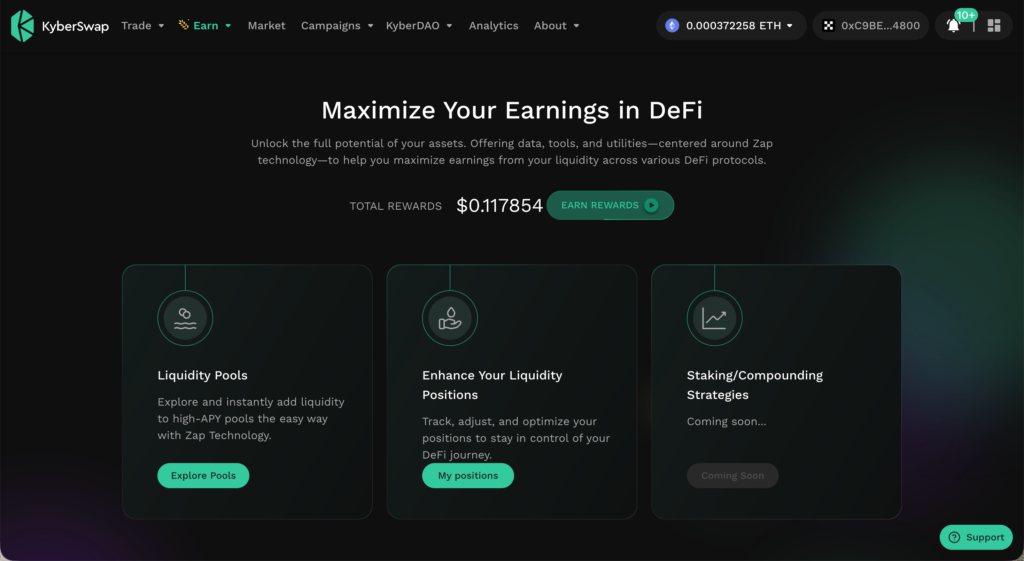
This guide explains the key liquidity pool performance metrics beginners should know and how KyberEarn 2.0 helps DeFi LPs discover, analyze, enter and manage liquidity positions in one place.
What Is Liquidity Pool Analytics?
Liquidity pool analytics is the data used to evaluate how a liquidity pool is performing.
Instead of looking only at headline APR, LPs can review trading volume, TVL, fees earned, reward sources, active liquidity and position performance. These metrics help LPs understand whether a pool has real demand or is mainly driven by temporary incentives.
For example, two pools may both show 50% APR. One may have strong trading volume and consistent fee generation. The other may have low organic activity but high short-term rewards.
The APR looks similar, but the quality of the opportunity is different.
Why Pool Analytics Matter for DeFi LPs
Liquidity provision is not risk-free. LPs are exposed to token price movement, impermanent loss, smart contract risk, changing rewards and out-of-range positions.
Good analytics help LPs track historical data:
- Compare pools across chains and protocols
- Understand whether APR comes from trading fees or incentives
- Check if a pool has real trading demand
- Monitor whether a position is in range
- Decide when to compound, reposition or exit
Without analytics, LPing becomes guesswork. With analytics, LPs can make more informed decisions.
Key Liquidity Pool Metrics Beginners Should Know
APR
APR estimates annualized return based on recent pool or position performance. It is useful for quick comparison, but it changes constantly. APR can rise or fall depending on trading volume, TVL, token price and reward programs. LPs should use APR as a starting point, not the full decision.
TVL
TVL means Total Value Locked. It shows how much capital is deposited in a pool. High TVL usually means deeper liquidity, but it can also reduce returns if fee generation is weak. Low TVL pools may offer higher APR, but they can be more volatile. A useful approach is to compare TVL with trading volume and fees.
Trading Volume
Trading volume shows how much swapping activity happens in a pool. This matters because LP fees usually come from swaps. A pool with consistent volume may generate more reliable fee income than a pool with only short-term volume spikes.
Fees Earned
Fees earned show how much trading fee income the pool has generated. This is important because fee income often reflects organic demand. If most of the yield comes from temporary rewards, the APR may drop when incentives end.
Active Liquidity
In concentrated liquidity pools, LPs choose a price range. If the market price stays inside that range, the position can earn fees. If the price moves outside the range, the position may stop earning fees. This is why active liquidity matters. It shows how much liquidity is actually in range and working.
Position Range
A narrow range can be more capital-efficient and may earn more fees when the price stays inside it. However, it has higher out-of-range risk. A wider range is usually less risky from an out-of-range perspective, but it may earn less efficiently. Beginners should choose a range based on risk tolerance, token volatility and market view.
Pool APR vs Position APR
Pool APR and position APR are not the same. Pool APR estimates performance at the pool level. Position APR depends on your selected price range, deposit size, active liquidity and earned fees. This is why your own return may be different from the pool’s headline APR. If your position is out of range or too wide, your actual performance may be lower. Position-level analytics help LPs understand how their own capital is performing.
How KyberEarn 2.0 Helps LPs Analyze Pools
KyberEarn 2.0 is designed to make DeFi liquidity provision easier to discover and manage.
Instead of switching between different DEXs, pool pages, dashboards and reward trackers, users can explore liquidity opportunities across supported protocols from one interface. KyberEarn supports liquidity opportunities from major protocols such as Uniswap, PancakeSwap, Aerodrome, SushiSwap and others.
KyberEarn does not operate the pools directly. It helps users interact with supported third-party pools through a more unified liquidity management experience.
KyberEarn 2.0 Features for LP Performance
KyberEarn 2.0 helps LPs before and after entering a position.
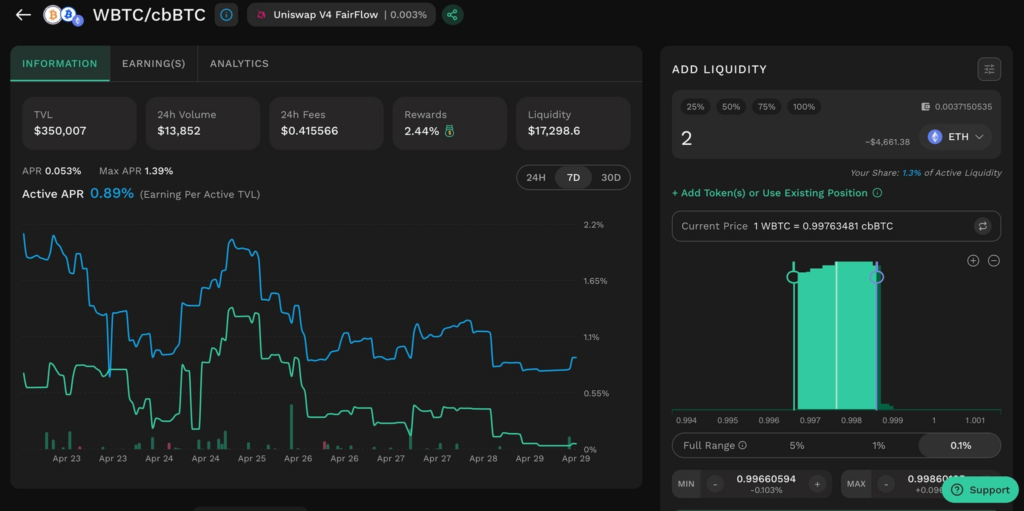
- Information — View pool metrics at a glance: TVL, 24h volume, 24h fees, rewards, liquidity utilization, and an interactive APR history chart over 24h, 7d, or 30d. The chart overlays Est. Pool APR, Active APR, and volume so you can see how yields have trended over time.
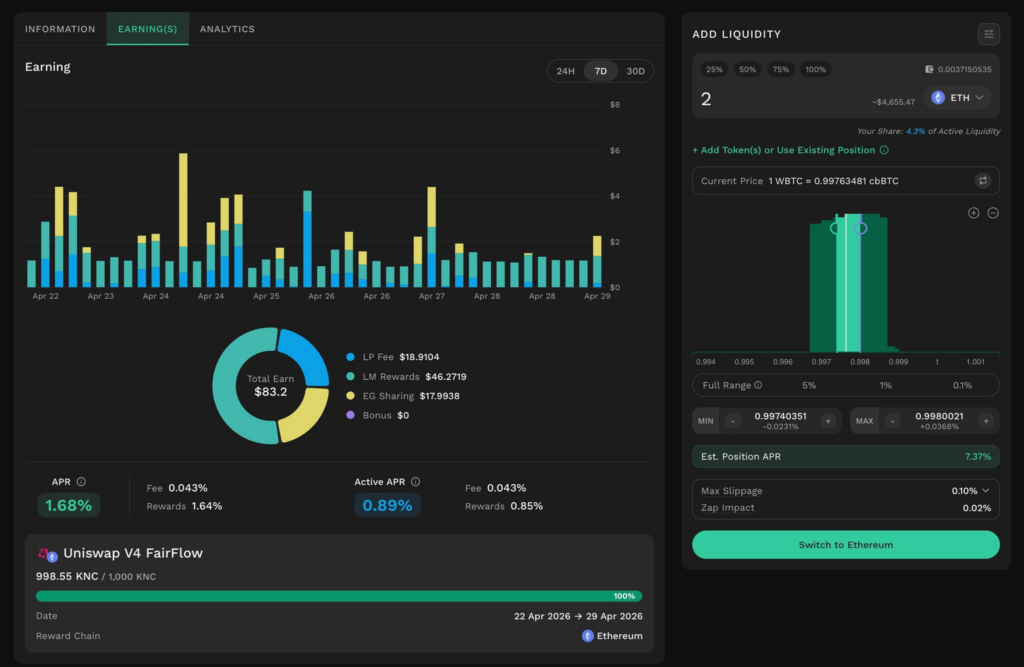
- Earning(s) — See the earning history for any pool, broken down by source: LP Fees, LM (Liquidity Mining) Rewards, EG (Equilibrium Gain) Sharing, and Bonus (other incentives). A donut chart shows the total earned and how it splits across sources, while a bar chart tracks daily earnings over your selected period. APR and Active APR are displayed with their fee and reward components side by side.
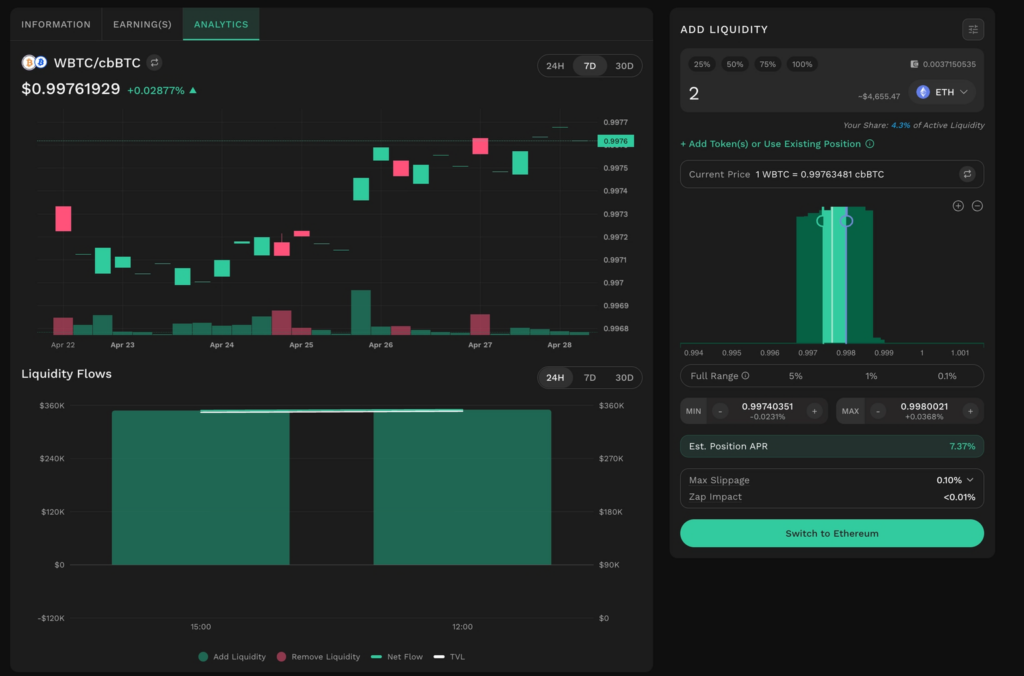
- Analytics — Access pool price candlestick charts (24h, 7d, 30d) powered by Token Settlement Price – derived from real on-chain swap events – alongside a liquidity flows chart showing add/remove activity, net flow, and TVL over time.
KyberEarn also includes KyberZap, which helps users enter supported liquidity positions using one token or multiple tokens. This reduces the friction of manually swapping tokens into the correct pool ratio.
For active management, users can monitor position status, accrued fees and rewards. They can also compound, reposition or withdraw supported positions more efficiently.
Smart Exit gives LPs a more structured way to withdraw liquidity based on predefined exit conditions, such as price threshold, target fee yield or time.
Basic Pool Page vs KyberEarn 2.0
| Feature | Basic DEX Pool Page | KyberEarn 2.0 |
|---|---|---|
| Pool discovery | Usually one protocol | Explore supported pools across protocols |
| APR display | Often one headline APR | Multiple APR metrics |
| Reward visibility | May be separate | Fee and reward breakdown |
| Entry flow | Manual token ratio setup | Zap in with one or multiple tokens |
| Position tracking | Protocol-specific | Track supported positions in one place |
| Exit planning | Manual withdrawal | Smart Exit for supported flows |
Risks LPs Should Understand
Liquidity provision carries risk. Before entering a pool, LPs should consider:
- Impermanent loss
- Out-of-range positions
- Smart contract risk
- Token volatility
- Changing reward programs
- Low liquidity or low volume
KyberEarn 2.0 helps users analyze and manage liquidity positions, but LPs should still review each pool carefully before depositing capital.
Beginner LP Checklist
Before adding liquidity, check:
- What tokens are in the pool?
- Is the pair stable, correlated or volatile?
- What is the TVL?
- What is the trading volume?
- How much fee revenue is the pool generating?
- Is the APR from fees, rewards or both?
- What price range will you choose?
- What happens if the position goes out of range?
- When should you compound, reposition or exit?
This checklist helps beginners avoid choosing pools based only on the highest APR.
Why KyberSwap Matters for DeFi LPs
KyberSwap is a Smart DeFi Hub that helps users discover, analyze, execute, track and optimize DeFi opportunities in one place.
For traders, KyberSwap Aggregator connects to over 420 liquidity sources across 17 chains to help users access better swap routes. KyberSwap has facilitated over US$150B in transaction volume and serves millions of users across DeFi.
For LPs, KyberEarn 2.0 brings the same idea to liquidity provision. It helps users compare pools, understand yield more clearly, enter positions with less friction and manage liquidity after depositing.
FAQ
What is liquidity pool analytics?
Liquidity pool analytics is the data used to evaluate pool performance, including APR, TVL, volume, fees, rewards, active liquidity and position performance.
Why should LPs not only look at APR?
APR changes often and may not reflect your actual position performance. LPs should also check volume, fees, TVL, rewards and risk.
What is the difference between Pool APR and Position APR?
Pool APR estimates performance at the pool level. Position APR reflects your own position based on your range, capital size and fees earned.
What is Active APR?
Active APR measures return based on liquidity that is currently in range and earning fees.
What is KyberEarn 2.0?
KyberEarn 2.0 is KyberSwap’s liquidity hub for discovering, analyzing, entering and managing liquidity positions across supported third-party protocols.
Can I add liquidity with one token on KyberEarn?
Yes. KyberZap helps users enter supported liquidity positions using a single token or multiple tokens.
Is liquidity provision safe?
Liquidity provision carries risk, including impermanent loss, smart contract risk, token volatility and out-of-range positions. LPs should always review pool data before depositing.
Conclusion
Liquidity pool analytics helps DeFi LPs make better decisions. Instead of chasing the highest APR, LPs should understand what drives returns and whether their own position is actually earning.
The most important metrics are APR, TVL, volume, fees, active liquidity, position range and reward breakdown.
KyberEarn 2.0 brings these insights into one LP-focused interface. With multiple APR metrics, pool categories, analytics, earning breakdowns, KyberZap, Smart Exit and position management tools, KyberEarn helps users move from simple yield discovery to smarter liquidity management.
For DeFi LPs, better data leads to better decisions.