Cross-chain swaps used to be a chore. Moving value between blockchains once meant juggling bridges, wrapped tokens, and a row of open browser tabs. Today you can do it in a single action from one screen. The catch is choosing where, because dozens of platforms promise the best cross-chain swap, and they do not all work the same way.
This guide compares five leading options: KyberSwap, Rango, THORChain, Squid, and Symbiosis. Some hold native liquidity, while others aggregate bridges and exchanges across many networks. The best choice depends on your chains, your assets, and whether you value price, speed, or trustlessness. By the end, you will know which tool fits which job.
What Is a Cross-Chain Swap?
A cross-chain swap turns a token on one blockchain into a different token on another, in one flow.
Say you hold ETH on Ethereum and want SOL on Solana. A cross-chain swap handles the bridge and the trade together, so you sign once and the output lands in your destination wallet. There is no manual bridging, and no wrapped-token detour to unwind later.
Two broad approaches exist in the market. Native protocols swap real Layer-1 assets through their own liquidity pools, while aggregators bridge an asset and then trade it on a DEX. Each method shapes speed, cost, and how much you need to trust the layer in the middle.
Cross-chain swaps matter more than ever in 2026. Liquidity now sits scattered across Ethereum, its Layer-2s, Solana, Bitcoin, and dozens of newer chains. A good cross-chain DEX pulls that fragmented liquidity into a single route, so you spend less time bridging and more time trading.
What Makes a DEX Good for Cross-Chain Swaps?
The best cross-chain DEX delivers the most output tokens with the least friction.
A handful of factors separate strong platforms from weak ones. Coverage decides whether your route even exists. Route quality decides how much value you keep once fees and slippage are counted. Speed, transparency, and security shape the rest of the experience.
Here are the key things to weigh before you swap:
- Chain and asset coverage, especially non-EVM chains like Bitcoin and Solana
- Route quality, meaning the real output amount after fees and slippage
- Speed and reliability of settlement across both chains
- Fee transparency, so you see the full cost before signing
- Security and custody, including whether you keep control of your funds
What Are the Top 5 DEXs for Cross-Chain Swaps?
Here are five platforms worth knowing, each solving the cross-chain problem a different way.
1. KyberSwap
KyberSwap’s Cross-Chain Swap feature pulls live quotes from eight established providers, including Across, Bungee, deBridge, LI.FI, Mayan, NEAR Intents, Relay, and Symbiosis, then selects the best rate automatically. Every alternative stays visible too, with its own fee and estimated arrival time, so you can weigh speed against price yourself.
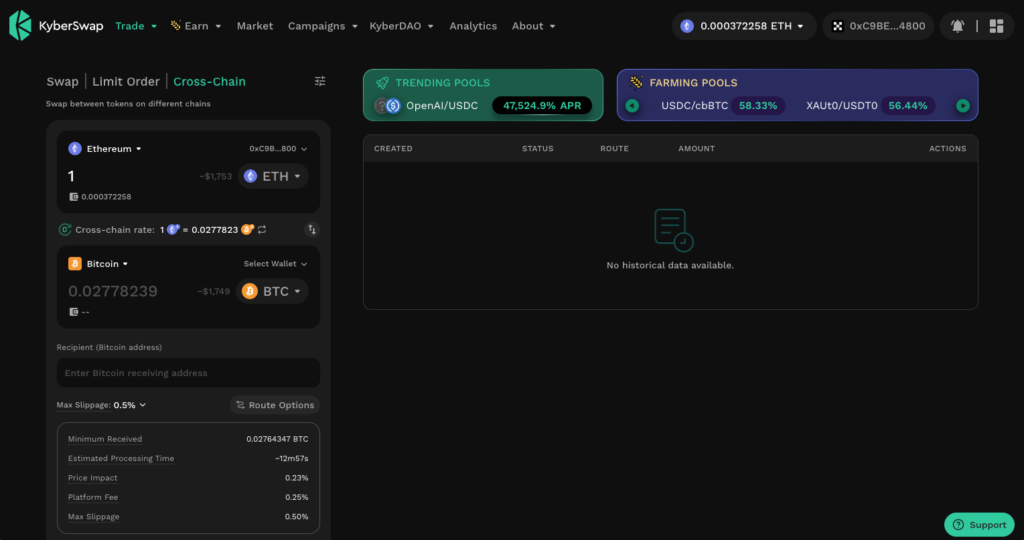
Main KyberSwap Offerings
Multi-provider comparison. Scans quotes from eight providers, including Across, deBridge, LI.FI, and Symbiosis, and selects the best rate by default.
Full route transparency. Shows every alternative route next to the winner, with its fee, protocol fee where one applies, and estimated arrival time.
23-chain reach. Covers major EVM chains plus Bitcoin, Solana, and NEAR through its aggregated providers.
KyberSwap’s aggregator connects to 420 or more liquidity sources across 17 chains, has facilitated more than $150 billion in transactions for over 5 million users, and consistently ranks first on EVM by trading volume. KyberSwap suits traders who want the best rate and broad coverage checked automatically, without opening several apps themselves.
2. Rango
It aggregates 120 or more DEXs and bridges across 73-plus chains, spanning EVM, Cosmos, Solana, Bitcoin, Tron, and long-tail networks like Aptos and StarkNet. The aggregator fee shows separately from the route itself, so the total cost stays visible before you sign.
Main Rango Offerings
Aggregated routing. Scans 120 or more DEXs and bridges to find the best price across 73-plus chains.
Non-EVM breadth. Reaches Cosmos, Solana, Bitcoin, Tron, Aptos, and StarkNet alongside standard EVM chains.
Transparent fees. The aggregator fee is shown separately from bridge and DEX costs, usually 0.1% to 0.3%.
3. THORChain
It settles trades through RUNE-paired liquidity pools, so BTC stays BTC and ETH stays ETH with no wrapping at any step. That design removes an entire category of bridge risk, since there is no wrapped asset to de-peg and no bridge contract to exploit.
Main THORChain Offerings
Native L1 settlement. Trades clear directly between chains without lock-and-mint bridging or synthetic assets.
Major-asset coverage. Supports around a dozen chains, including Bitcoin, Ethereum, Litecoin, Dogecoin, and Monero, added in 2026.
Full custody. Users hold their keys throughout the swap, with no custodial intermediary step.
4. Squid
Squid routes through the Axelar network using an intent engine called CORAL.
It covers 100 or more chains and over 20,000 tokens, including Solana, Cosmos, XRPL, Stellar, and Hedera. Rather than a single fixed route, CORAL runs a solver auction, where competing solvers bid to fill each trade.
Main Squid Offerings
Solver auction execution. CORAL lets solvers compete for each trade, which tends to sharpen pricing on liquid routes.
Deep non-EVM reach. Covers Solana, Cosmos, XRPL, Stellar, and Hedera alongside standard EVM chains.
Wide embedded distribution. Powers cross-chain features inside 1,000-plus apps, including MetaMask and Ledger.
5. Symbiosis
Symbiosis blends a cross-chain AMM with meta-aggregation.
It compares routes across many DEXs and bridges, then executes across 50-plus networks including Ethereum, Solana, BNB Chain, TON, Tron, and Bitcoin. Its own Octopool liquidity gives Symbiosis a base layer to route through even when third-party liquidity runs thin.
Main Symbiosis Offerings
Route comparison plus AMM liquidity. Compares DEX and bridge routes, then falls back on its own Octopools when needed.
Non-custodial security. Relayer transfers are secured with MPC and a threshold signature scheme.
Broad EVM and non-EVM reach. Covers 50-plus networks, including Bitcoin, Solana, and TON alongside EVM chains.
Cross-Chain DEX Comparison Table
| DEX | How It Works | Chains | Non-EVM Reach | Aggregates Other Providers |
|---|---|---|---|---|
| KyberSwap | Compares 8 established providers, auto-selects best rate | 23 | Bitcoin, Solana, NEAR | Yes, including Across, deBridge, LI.FI, Relay, Symbiosis |
| Rango | Universal aggregator, 120+ sources | 73+ | Bitcoin, Cosmos, Tron, Solana | No, aggregates DEXs and bridges directly |
| THORChain | Native L1 pools, no bridges | 13+ | Bitcoin, Litecoin, Dogecoin, Monero | No |
| Squid | Axelar intent router (CORAL) | 100+ | Solana, Cosmos, XRPL, Bitcoin | No |
| Symbiosis | Cross-chain AMM plus aggregation | 50+ | Bitcoin, Solana, TON, Tron | No, aggregates DEXs and bridges directly |
How to Do a Cross-Chain Swap on KyberSwap
The flow takes about a minute and stays on one screen.
- Open the Cross-Chain tab on KyberSwap and connect your wallet on the source chain.
- Select your source network, your destination network, and the token pair you want.
- Enter the amount, then add a receiving address if the destination is Bitcoin, Solana, or NEAR.
- Review the best-rate route, or expand the options to compare providers, fees, and arrival times.
- Approve the token if prompted, confirm the swap, and follow its status in real time.
Which Cross-Chain DEX Should You Use?
Your best pick still depends on what you are optimizing for.
If you want the best rate checked across multiple providers without doing that comparison yourself, KyberSwap is the strongest all-around choice. If you need trustless native swaps of major coins, THORChain is built for exactly that. Rango wins when your priority is reaching a long-tail chain, Squid is worth a look for fast non-EVM routes, and Symbiosis suits traders who want a non-custodial AMM with wide reach on its own.
Frequently Asked Questions
What is the best DEX for cross-chain swaps?
It depends on your priority. KyberSwap suits most users by comparing several providers and picking the best rate, while THORChain fits trustless native swaps and Rango offers the widest chain coverage.
Are cross-chain swaps safe?
They involve more moving parts than single-chain trades. Non-custodial platforms let you keep control of your funds, and aggregators lower risk by routing through audited providers. Always check the route and fees before you confirm.
How long does a cross-chain swap take?
Most finish within seconds to a few minutes. Timing depends on the chains involved and current network congestion. Bitcoin routes usually take longer than EVM-to-EVM swaps.
Can I swap Bitcoin across chains on a DEX?
Yes. KyberSwap, Rango, THORChain, Squid, and Symbiosis all support Bitcoin routes. Many EVM-only aggregators do not, so confirm coverage first.
Do cross-chain swaps need wrapped tokens?
Not always. THORChain swaps native assets directly through its own pools. Aggregators such as KyberSwap may route through bridges that use wrapped assets, then deliver the native token you asked for.
What fees do cross-chain swaps charge?
Expect a platform or aggregator fee plus the underlying bridge and DEX costs. KyberSwap charges 0.05% to 0.25% by route, and it shows the full cost before you sign.
Why use KyberSwap for cross-chain swaps?
KyberSwap compares eight cross-chain providers in one place and picks the best rate for you, rather than locking you into a single bridge. It also reaches non-EVM chains like Bitcoin, Solana, and NEAR, and it backs that reach with a $150 billion-plus track record.
Does KyberSwap support native asset bridging?
Yes, through the providers it aggregates. KyberSwap’s Cross-Chain Swap routes through Across, Bungee, deBridge, LI.FI, Mayan, NEAR Intents, Relay, and Symbiosis, so bridging routes from those established protocols are available inside one interface instead of eight separate apps.
Is KyberSwap fast for cross-chain swaps?
It can be, since deBridge and Across are two of its aggregated providers and both are known for near-instant EVM-to-EVM settlement. KyberSwap shows the estimated arrival time for every route before you confirm, so you can pick the fastest option directly.
Are KyberSwap’s cross-chain fees competitive?
KyberSwap charges a 0.05% to 0.25% platform fee on top of the selected provider’s own fee. Because it compares total cost across eight routes at once, it is well placed to surface the cheapest combination rather than whatever one bridge charges that day.
How many blockchains does KyberSwap support for cross-chain swaps?
KyberSwap’s Cross-Chain Swap feature reaches 23 blockchain networks directly, including Bitcoin, Solana, and NEAR alongside major EVM chains. That number grows as KyberSwap integrates additional providers, since each one brings its own chain list.