This guide ranks the best platforms for swap execution rate, explains the mechanics behind the ranking, and compares how each one decides where your order goes.
What Makes a Good Swap Execution Rate
A good rate is not one number. It is the result of three things working together.
Liquidity depth determines how much a trade moves the price. Deeper pools absorb size with less price impact, so large orders survive better on platforms that reach more liquidity sources.
Routing intelligence decides how the order is broken up. A strong router splits a single swap across several pools and several hops, then compares the combined output against simpler paths.
Slippage behaviour is the gap between the quoted rate and the settled rate. Markets move between quoting and confirmation, and the platforms that handle that window well protect more of your output.
Quote Time vs Execution Time
Most aggregators lock your route before you submit the transaction.
The router scans liquidity sources, picks the best path it can find, and hands you a quote. In many routing models, everything after that is largely outside the router’s control. Between quoting and settlement, liquidity can be pulled, a searcher can front run the transaction, and a market maker can widen the spread it showed moments earlier.
This is why quoted rates and received amounts drift apart. The decision was made at quote time, but the trade settles at execution time, and those are two different market states. The platforms that close this gap are the ones that deliver the most consistent execution rates, which is the main reason the ranking below looks the way it does.
Best Platforms for Swap Execution Rate
KyberSwap
KyberSwap is a DEX aggregator that routes swaps across a wide set of liquidity sources on multiple chains, including AMMs, PMM, and proAMMs.
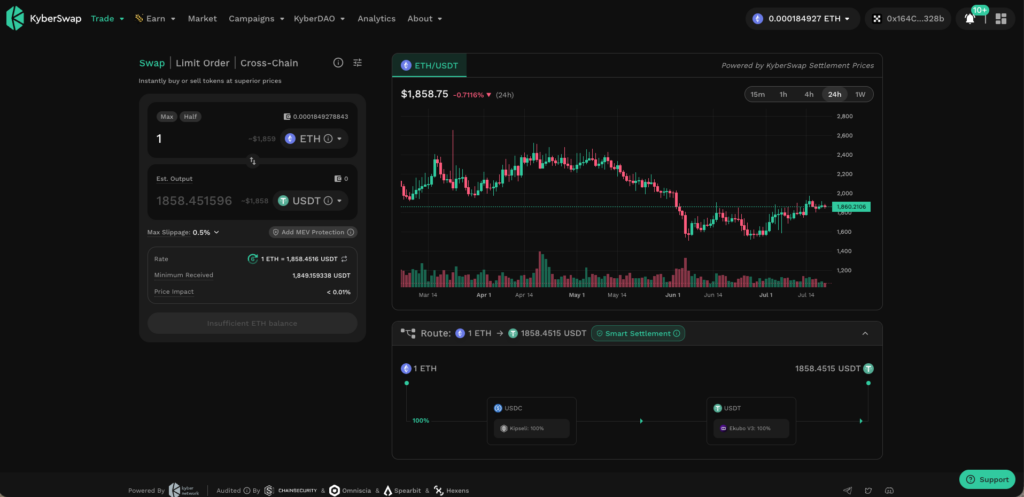
Its routing engine, Dynamic Trade Routing, evaluates available liquidity at quote time and builds a route that can split a single swap across multiple pools and hops. The engine optimizes for the highest expected net output rather than simply the lowest quoted price.
What differentiates KyberSwap is what happens after the quote. Smart Settlement adds an onchain decision layer that operates during execution, within the same transaction. It compares multiple candidate pools in real time and selects the one delivering the highest available output for each hop of the swap.
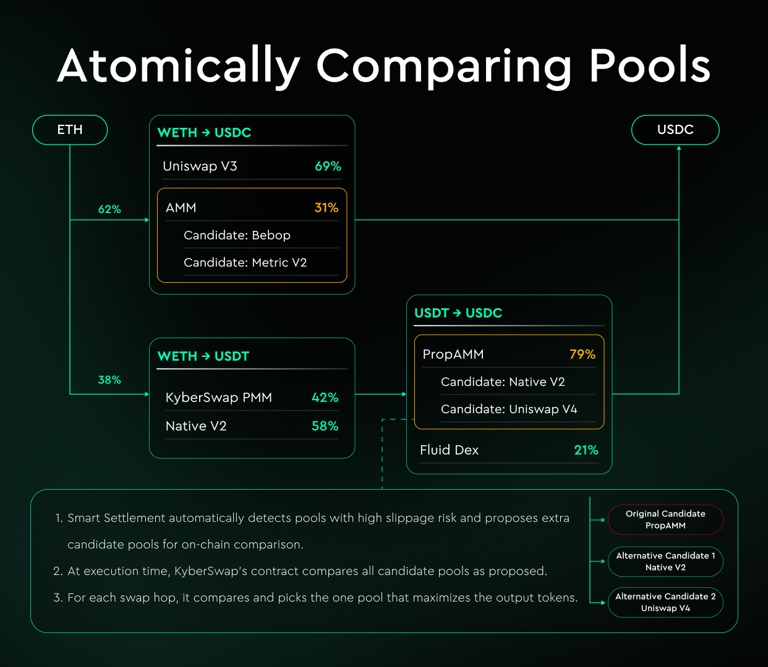
The comparison happens atomically within the transaction and requires no extra action from the user. Because the final pool selection is made at settlement, execution can reflect live market conditions rather than conditions that existed when the quote was generated. This helps reduce the gap between quoted and received amounts.
This addresses situations that quote-time routing alone cannot fully account for. If a propAMM widens its spread before settlement, Smart Settlement can switch to a better candidate pool when one is available. If liquidity providers remove depth after the quote is generated, it can select another pool with sufficient liquidity. If execution conditions deteriorate before settlement, Smart Settlement can also move to another eligible candidate when available.
Smart Settlement can also reduce revert risk by maintaining alternative execution candidates. If the primary route no longer satisfies slippage requirements, another candidate may execute successfully instead. Smart Settlement adds no protocol fee, and KyberSwap does not charge users a platform fee for swaps through the aggregator.
Traders who need more control have two additional tools. Limit Order lets you set your desired execution price and wait for the market to reach it, with no gas paid unless the order is filled. Cross-chain Swap lets you move assets across supported networks in a single flow, with routing handled on both sides of the transaction.
This combination differentiates KyberSwap from most DEX aggregators. It optimizes routes before submission and then re-evaluates execution during settlement through Smart Settlement, a capability that remains uncommon among DEX aggregators. It is particularly well suited for large orders, low-liquidity tokens, newly launched assets, and volatile meme tokens where the difference between quoted and received output can be more pronounced.
1inch
1inch is a DEX aggregator with broad EVM chain coverage and a long track record. Its Pathfinder algorithm splits orders across multiple protocols and hops to improve output on larger trades.
The platform also offers Fusion mode, which passes orders to professional resolvers that compete to fill them. Standard swaps rely on quote-time routing, while Fusion uses competing resolvers to improve execution quality.
CoW Swap
CoW Swap uses batch auctions rather than direct pool routing. Orders are collected into batches, and solvers compete to settle them at the best available price.
When two traders in the same batch want opposite sides of a pair, they can be matched directly, which avoids AMM fees entirely. The model provides strong MEV protection, and settlement is not instant, since orders wait for a batch.
Jupiter
Jupiter is the dominant aggregator on Solana and routes across the chain’s AMMs and order books. It supports multi-hop routes and order splitting across the ecosystem’s liquidity venues.
Coverage is the constraint. Jupiter is built for the Solana ecosystem, so traders operating across EVM chains need a second platform alongside it.
Matcha
Matcha is the trading interface built on 0x infrastructure, aggregating both AMM liquidity and professional market maker quotes. Its request for quote system can produce competitive pricing on major pairs.
The interface is clean and shows a clear breakdown of the route before confirmation. Final execution still depends on market conditions remaining close to the quoted state until settlement.
Velora
Velora, previously ParaSwap, aggregates liquidity across major EVM chains and uses its own routing algorithm to split orders. It supports both AMM pools and market maker liquidity.
Coverage is solid across established chains, and the routing model follows the standard quote time approach used by most aggregators.
Why Execution Rate Matters More Than the Quoted Price
Two platforms can display nearly identical quoted output while delivering noticeably different final results after settlement. What ultimately matters is the amount that arrives in your wallet, not the amount shown before you sign the transaction.
Execution quality depends on multiple factors, including routing intelligence, liquidity depth, price impact and how effectively a platform adapts to changing market conditions between quote time and settlement. A platform that consistently narrows the gap between quoted and received output will generally provide better swap execution over time.
Swap Execution Rate Comparison
| Platform | Routing model | When the route is decided |
|---|---|---|
| KyberSwap | DEX aggregator with Dynamic Trade Routing and Smart Settlement | Quote time, with execution-time pool selection via Smart Settlement |
| 1inch | DEX aggregator with resolver based Fusion mode | Quote time |
| CoW Swap | Batch auction with competing solvers | Batch settlement |
| Jupiter | DEX aggregator | Quote time |
| Matcha | Aggregator with RFQ market maker quotes | Quote time |
| Velora | DEX aggregator | Quote time |
How to Get the Best Swap Rate on KyberSwap
Getting the best rate takes four steps.
- Open the KyberSwap swap page and connect your wallet.
- Select your input and output tokens, choose the network, and enter the amount.
- Review the quoted output and the route breakdown, then adjust slippage tolerance if the pair is volatile.
- Confirm the swap and let routing handle pool selection at execution.
For a rate better than the current market price, use Limit Order instead. Set your target rate, set an expiry, and the order fills only when the market reaches it.
Frequently Asked Questions
What is swap execution rate?
Swap execution rate is the effective rate you receive when a trade settles. It accounts for routing, price impact, slippage, and fees, so it is usually different from the quoted rate shown before submission.
Which platform gives the best swap rate?
No single platform delivers the best rate on every trade because liquidity changes constantly across pools, chains and market makers. The best choice depends on the chain, token pair, trade size and current market conditions.
DEX aggregators generally outperform individual DEXs because they compare liquidity from many sources. Among them, KyberSwap further differentiates itself by using Smart Settlement to re-evaluate pool selection during execution, helping reduce the gap between quoted and received output.
Why does the rate I get differ from the rate I was quoted?
Market conditions change between quoting and settlement. Liquidity can be removed, other trades can move the pool price, and market makers can widen spreads, all of which reduce your output below the quote.
Does KyberSwap charge a fee on swaps?
KyberSwap does not charge users a platform fee for swapping through the aggregator. You still pay the trading fees charged by the underlying pools you route through.
Can I get a better rate using a limit order?
Yes, if you are willing to wait. A limit order fills only at your specified rate or better, which removes slippage from the equation but gives no guarantee the order fills.
Is a cross-chain swap rate worse than a single-chain swap?
Cross-chain swaps involve routing on two chains plus a bridging step, so costs are typically higher than a comparable single-chain trade. The rate depends on liquidity depth for the pair on both sides of the route.