Robinhood Chain went live on July 1, 2026, and token activity followed almost immediately. New assets launch on the network daily, and the fastest movers change week to week. Finding them takes the right interface, and buying them takes the right execution. This guide covers both.
What Are Trending Tokens on Robinhood Chain?
Trending tokens are the assets pulling the most onchain trading activity at any given moment.
Robinhood Chain is a permissionless Ethereum Layer 2 built using Arbitrum technology. It settles transactions on Ethereum, uses ETH for gas, and runs 100ms block times. Anyone can deploy a contract on the network without approval from a gatekeeper.
That permissionless design explains why token lists move so quickly here. The network drew close to 800,000 lifetime active addresses within its first two weeks. It processed 3.6 million transactions in a single day and cleared roughly $838 million in DEX volume over 24 hours, ranking among the top five chains by decentralized exchange volume.
Total value locked sat near $312 million in mid-July 2026, with total asset market cap around $480 million. Speculative trading, rather than tokenized equities, has driven most of that early growth. For traders, this means opportunity arrives fast and rotates just as fast.
Which Tokens Are Trending on Robinhood Chain?
The Robinhood Chain token wave spans several categories, not just memecoins.
CASHCAT is the largest memecoin on the network by market cap. The name references what Robinhood was called in its earliest days, which gave the token instant recognition and a fast start.
TENDIES leans on retail trading culture and sits in CoinGecko’s dedicated Robinhood Chain meme category. Turnover has stayed among the highest on the network since launch.
PONS is the token behind Pons, a non-custodial launchpad on Robinhood Chain. Tokens created there deploy with a fixed supply into a Uniswap V3 pool quoted against WETH, and pool liquidity locks automatically at creation.
STONKBROKER anchors an NFT ecosystem on the chain, pairing a 4,444-piece collection with its own ERC-20 token and a stock-token reward mechanic.
INDEX takes a different angle entirely. The project describes itself as a stock-dividend protocol for tokenized stocks, making it one of the first RWA-adjacent tokens to attract meaningful liquidity on the network.
Rankings shift daily on a chain this young. Treat the list above as a snapshot from July 2026 rather than a fixed leaderboard.
Where To Find Trending Tokens on Robinhood Chain?
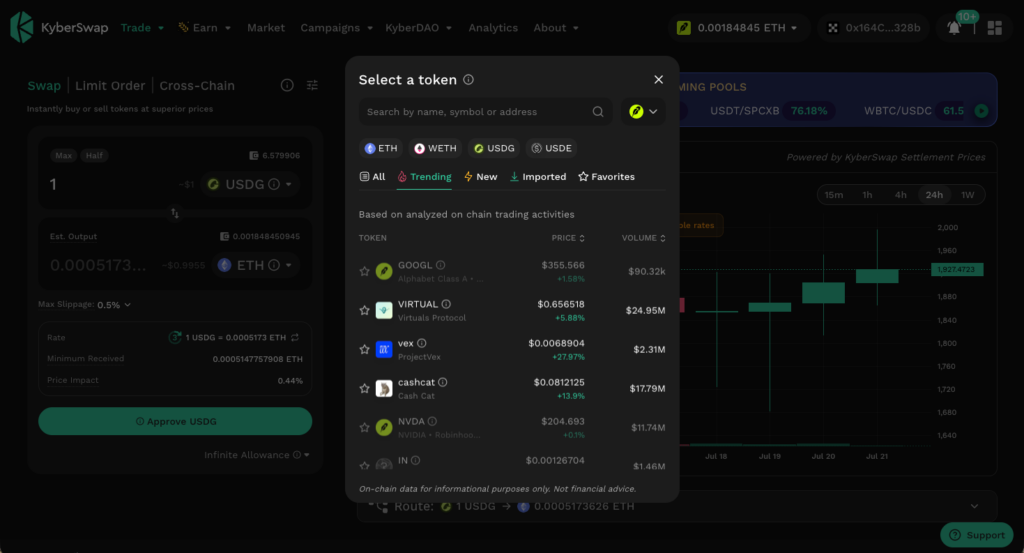
KyberSwap surfaces trending Robinhood Chain tokens inside the token selector itself.
Open the token list on the swap interface and two discovery tabs appear. The Trending tab ranks tokens based on analyzed onchain trading activity, so the list reflects what is genuinely moving on the network rather than what is loud on social media.
The New tab lists tokens recently whitelisted on KyberSwap. Each entry carries an age badge such as 3D or 5D, telling you at a glance how long that token has been available. Both tabs display live price and 24-hour volume, and either column can be sorted.
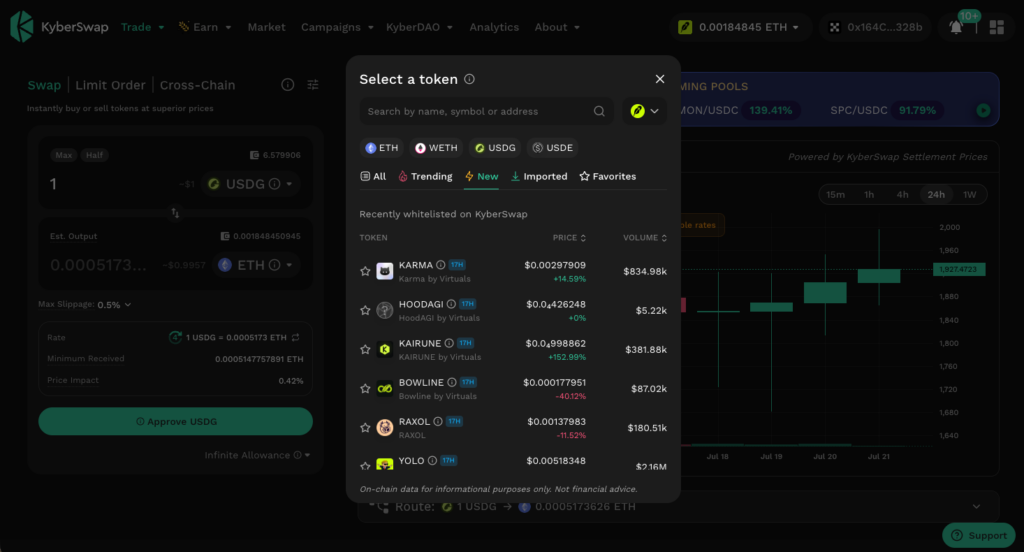
Search works by name, symbol, or contract address, which matters when a token is too new to appear in any list. Anything worth tracking can be starred under Favorites for later.
How To Buy Trending Tokens on Robinhood Chain
Buying takes six steps once your wallet is ready.
- Open kyberswap.com and select Robinhood Chain. Switch networks from the interface before you start looking for tokens.
- Find your token. Use the Trending or New tab, or paste the contract address straight into the search field.
- Review and confirm. Check the quoted rate and price impact, then approve the transaction in your wallet.
What Trading Tools Can You Use on Robinhood Chain?
KyberSwap runs three trading tools on Robinhood Chain, and each fits a different situation.
Swap
Swap is the default route when you want a trending token immediately. The KyberSwap Aggregator connects to over 420 liquidity sources, then splits and reroutes each trade through the most capital-efficient pools available.
That routing matters more on a young network than an established one. Liquidity for a new token often sits scattered across several small pools, and a single-venue trade can miss most of it. Aggregating those sources into one route protects your output.
Limit Order
Limit Order lets you name your rate and step away. Creating and cancelling orders is gasless for makers, and an order settles onchain only when your price condition is met.
Your tokens stay in your wallet the entire time. Ownership transfers only once a matching trade is found, which suits volatile assets where the entry you want may arrive at 3am.
Cross-chain Swap
Cross-chain Swap gets you onto Robinhood Chain without a separate bridging step. KyberSwap covers 23 networks across EVM and non-EVM chains, aggregates quotes from multiple cross-chain providers, and selects the best rate automatically.
You keep full visibility throughout. Routes, fees, and estimated arrival times are all comparable before you commit to anything.
| Tool | Best For | How It Executes | Where You Start |
|---|---|---|---|
| Swap | Entering a moving token now | Routes across 420+ liquidity sources | Robinhood Chain |
| Limit Order | Setting a target entry and waiting | Settles onchain when your price is met | Robinhood Chain |
| Cross-chain Swap | Arriving from another network | Compares provider quotes, then bridges and swaps | Any of 23 supported networks |
How Do You Check a Trending Token Before Buying?
New tokens carry real risk, and four checks remove most of the avoidable part.
Start with the contract address. Names and tickers are trivial to copy on a permissionless launchpad, so match the address against the project’s official channels before trading anything.
Liquidity and price impact come next. A token sitting in thin pools will move sharply against your order, and the price impact figure on your quote tells you exactly how much.
Token age is the third check. Age badges in the New tab make this immediate, and an asset a few days old has almost no trading history to judge it by.
Finally, consider setting a limit order rather than chasing a candle. Choosing your entry rate in advance takes the guesswork out of timing a market that trades around the clock.
FAQ
What is Robinhood Chain?
Robinhood Chain is a permissionless Ethereum Layer 2 built using Arbitrum technology. It settles transactions on Ethereum, uses ETH for gas, and was designed for financial services and tokenized real-world assets.
What do I need to start trading on Robinhood Chain?
You need an EVM-compatible wallet, the network added at chain ID 4663, and ETH to cover gas. Nothing else is required, because the network is open to anyone.
Which token pays for gas on Robinhood Chain?
ETH pays for gas, exactly as it does on Ethereum. Transaction fees run a fraction of a cent.
How does KyberSwap decide which tokens are trending?
The Trending tab is built on analyzed onchain trading activity across the network. Rankings therefore reflect real trading behavior instead of social sentiment.
What does the New tab show?
It lists tokens recently whitelisted on KyberSwap, each carrying an age badge showing how many days it has been available. This is the fastest way to see what launched during the past week.
Can I buy Robinhood Chain tokens from another network?
Yes. Cross-chain Swap connects 23 networks, so you can start from Ethereum, Base, Arbitrum, or another supported chain and arrive holding the token you want.
Is trading on Robinhood Chain risky?
Any permissionless network carries risk, and a young one carries more. Contract verification, liquidity depth, and token age are the checks that matter most before committing funds.