Discover why developers choose KyberSwap DEX Aggregator API to power trading in their applications, from better pricing to seamless integration and execution reliability.
What is a DEX Aggregator?
A DEX aggregator is a tool or API that connects to multiple decentralized exchanges and liquidity sources, then determines the most efficient way to execute a trade. Instead of relying on a single exchange, it:
- Scans liquidity across many DEXs
- Compares prices and available depth
- Splits trades across multiple pools if needed
- Optimizes routes in real time
For example, a single token swap might be executed across several liquidity pools on different platforms to achieve a better final output.
As decentralized finance continues to evolve, developers face a critical challenge: how to deliver the best trading experience without building complex infrastructure from scratch. A DEX aggregator API solves this by sourcing liquidity across multiple protocols. But not all aggregators are equal. KyberSwap stands out by focusing not only on pricing but also on execution quality, scalability, and developer usability.
1. Best rates through an advanced algorithm
KyberSwap’s core advantage starts with how it approaches liquidity. Instead of relying on a single DEX or pool, the aggregator scans a wide range of liquidity sources across the ecosystem and constructs the most efficient route for every trade.
It does not simply pick the best pool. It can:
- Split trades across multiple sources
- Optimize routes in real time
- Prioritize maximum output
This means even complex trades with large size or low liquidity pairs can still achieve strong pricing. The system is designed to maximize the final amount received by the user, not just display an attractive quote.
Why this matters: Pricing is the most visible outcome for users. Better rates directly translate into higher satisfaction, stronger retention, and increased trading volume for any application integrating KyberSwap.
2. Deep liquidity and integrations
KyberSwap provides developers with access to one of the deepest and most diverse liquidity networks in DeFi. Instead of relying only on traditional AMMs, it aggregates liquidity from over 420+ sources, including AMMs, PMMs, and propAMMs.
This expanded coverage means KyberSwap is not limited to passive pool liquidity. It can also tap into professional market makers and proprietary liquidity strategies that often offer better pricing and tighter spreads, especially for large or complex trades.
By integrating multiple liquidity models, KyberSwap is able to:
- Access deeper liquidity across a wider range of token pairs
- Reduce price impact for large trades
- Deliver more consistent execution across different market conditions
Beyond liquidity, KyberSwap is also deeply integrated into the broader DeFi ecosystem. It is trusted and used by leading infrastructure and aggregation platforms such as LI.FI and LlamaSwap. These integrations validate both the quality and reliability of KyberSwap’s routing and execution capabilities.
Why this matters: For developers, deeper liquidity and strong ecosystem integrations translate into better pricing, higher execution success, and a more competitive product without needing to build complex liquidity connections from scratch.
3. Execution quality you can rely on
In DeFi, there is often a gap between the quoted price and actual execution. Many APIs return the best theoretical route, but fail when market conditions change between the quote and the transaction.
KyberSwap is built with execution in mind, not just routing. It improves execution quality by:
- Adapting routes dynamically as onchain conditions evolve
- Minimizing slippage between quoted and final output
- Reducing the likelihood of failed or reverted transactions
This focus ensures that users receive outcomes that closely match expectations, even in volatile markets.
Why this matters: Execution quality defines trust. If users consistently receive worse results than quoted, they leave. KyberSwap helps developers deliver a trading experience users can rely on.
4. Multi-chain integration made simple
Liquidity in DeFi is fragmented across multiple chains. Supporting each network individually can quickly become complex and resource-intensive for developers.
KyberSwap solves this with a unified Aggregator API that works across multiple EVM-compatible chains. Instead of building separate integrations, developers can access:
- Ethereum
- Arbitrum
- Optimism
- Base
- BNB Chain
- and other supported networks
All through a consistent interface. This allows applications to expand across ecosystems without rewriting core logic or maintaining multiple integrations.
Why this matters: Time to market is critical. A single integration that unlocks multiple chains reduces engineering overhead and allows teams to scale faster.
5. Developer-first and easy to integrate
KyberSwap is designed to reduce complexity for developers while still offering flexibility for advanced use cases.
The API follows a clear and intuitive workflow:
Quote → Build → Execute
- Quote: Retrieve the best route and expected output
- Build: Generate transaction calldata ready for signing
- Execute: Send the transaction through the user’s wallet
Why this matters: A clean developer experience reduces integration time, lowers the risk of bugs, and allows teams to focus on building differentiated products instead of infrastructure.
Conclusion
KyberSwap Aggregator API is more than a liquidity router. It is a complete execution layer built for real-world DeFi conditions. By combining best-rate aggregation, reliable execution, deep liquidity access, multi-chain support, and a developer-first design, it enables teams to build faster and deliver better trading outcomes.
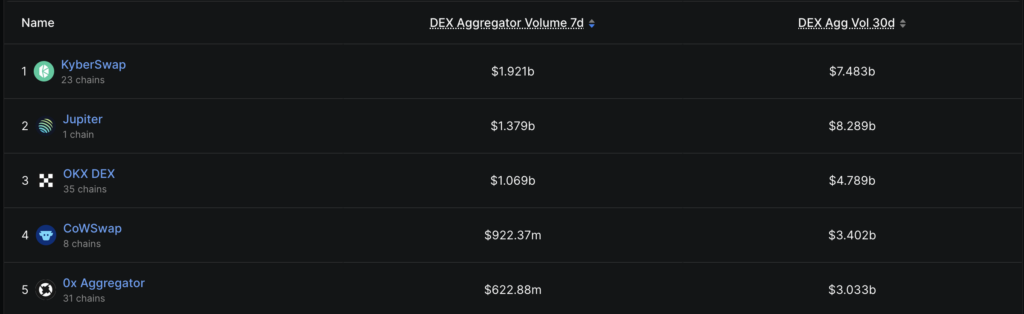
This performance is reflected at scale. KyberSwap is the #1 DEX aggregator on EVM by volume, facilitating over $10B in monthly trading volume. This level of adoption signals strong trust from both users and partners, and proves the system works under real market conditions.
For developers, this means you are not just integrating an API. You are building on top of infrastructure that is already battle-tested at the highest level of DeFi.
Start now: https://docs.kyberswap.com/developer-guide/start-here