Finding the best place to swap tokens is not only about choosing a popular app. The real goal is simple: receive more tokens after the swap executes while avoiding unnecessary slippage, poor routes, and fragmented liquidity.
In DeFi, liquidity is spread across many DEXs, AMMs, PMMs, propAMMs, and market makers. A single pool may look good for one trade but become inefficient for another. That is why many traders use DEX aggregators instead of swapping directly on one DEX.
A DEX aggregator checks multiple liquidity sources, compares available routes, and helps users access better pricing from one interface. For users who care about best rate and low slippage, this is usually the strongest starting point.
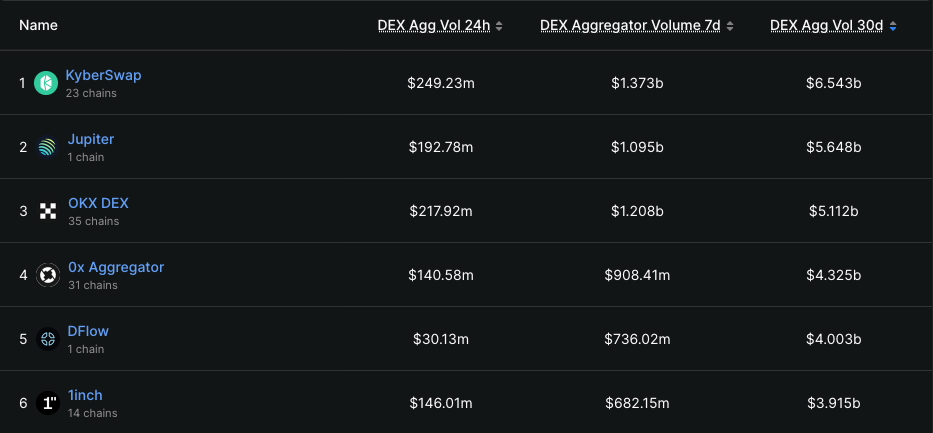
Top 6 DEX Aggregators by 30d Volume
Based on DeFiLlama’s DEX aggregator volume data as of May 28, 2026, the top 6 DEX aggregators by 30d volume are:
| Rank by 30d Volume | DEX Aggregator | Chains | 24h Volume | 7d Volume | 30d Volume |
|---|---|---|---|---|---|
| 1 | KyberSwap | 23 | $249.23M | $1.373B | $6.543B |
| 2 | Jupiter | 1 | $192.78M | $1.095B | $5.648B |
| 3 | OKX DEX | 35 | $217.92M | $1.208B | $5.112B |
| 4 | 0x Aggregator | 31 | $140.58M | $908.41M | $4.325B |
| 5 | DFlow | 1 | $30.13M | $736.02M | $4.003B |
| 6 | 1inch | 14 | $146.01M | $682.15M | $3.915B |
Volume is not the only factor that matters. Users should also consider liquidity depth, route quality, supported chains, slippage controls, execution reliability, wallet experience, and advanced tools such as limit orders or cross-chain swaps.
Higher volume often shows that users and integrators are actively routing trades through the platform. In the current DeFiLlama snapshot, KyberSwap leads the DEX aggregator category by 24h, 7d, and 30d volume among the listed top platforms.
1. KyberSwap: Best Overall for Best Rate and Low Slippage
KyberSwap is an all-in-one DeFi platform that helps users discover, analyze, execute, track and optimize DeFi opportunities in one place. For token swaps, KyberSwap Aggregator routes trades across multiple DEXs and liquidity sources to help users receive better output without manually checking many platforms.
KyberSwap has facilitated over US$150B in transaction volume and connects to 420+ liquidity sources across 23 chains, helping users access deeper liquidity and more efficient routing across DeFi.
The biggest reason KyberSwap stands out is that it is not only built for showing a good quote. It is built around the full swap experience. It helps users access better rates, lower slippage, stronger execution, and a smoother trading experience.
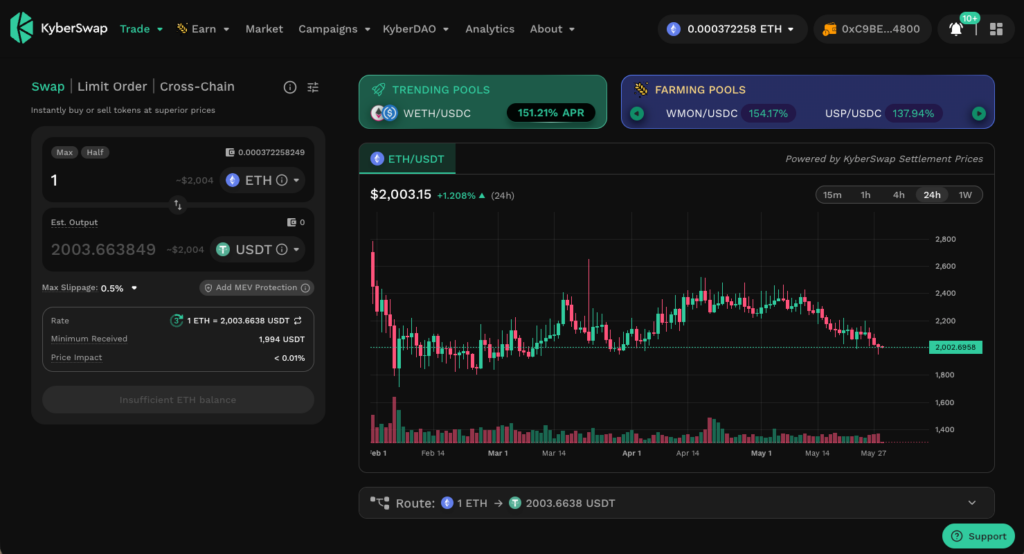
Key offerings of KyberSwap
Best-rate aggregation with deep liquidity
KyberSwap compares routes across hundreds of liquidity sources so users do not need to manually check individual DEXs. This matters because the best price for a token pair can change depending on liquidity depth, trade size, volatility, and onchain conditions.
For example, a small ETH to USDC swap may route well through one pool. A larger volume swap may need to be split across multiple pools or use a different path to reduce price impact.
KyberSwap handles this behind the scenes while giving users more tools to understand and improve their swap before execution.
Smarter swap features for better execution and protection
Dynamic Slippage suggests a more realistic slippage setting to users when a swap fails because the original slippage is too low. It uses the estimated actual slippage returned by the Aggregator API, then applies a category-based buffer and cap to suggest a practical setting. This aims to reduce retry friction while still protecting users from overly aggressive slippage settings.
Pricing Chart gives users market context before swapping. Instead of jumping between different platforms to check price movement, users can review token price trends directly inside the swap flow. This makes it easier to understand the market context and take the right action.
Trade Route shows how the swap is being routed across liquidity sources. Users can see whether the trade is going through one route, multiple pools or split paths. This adds more transparency to the swap process and helps users understand how KyberSwap finds better output.
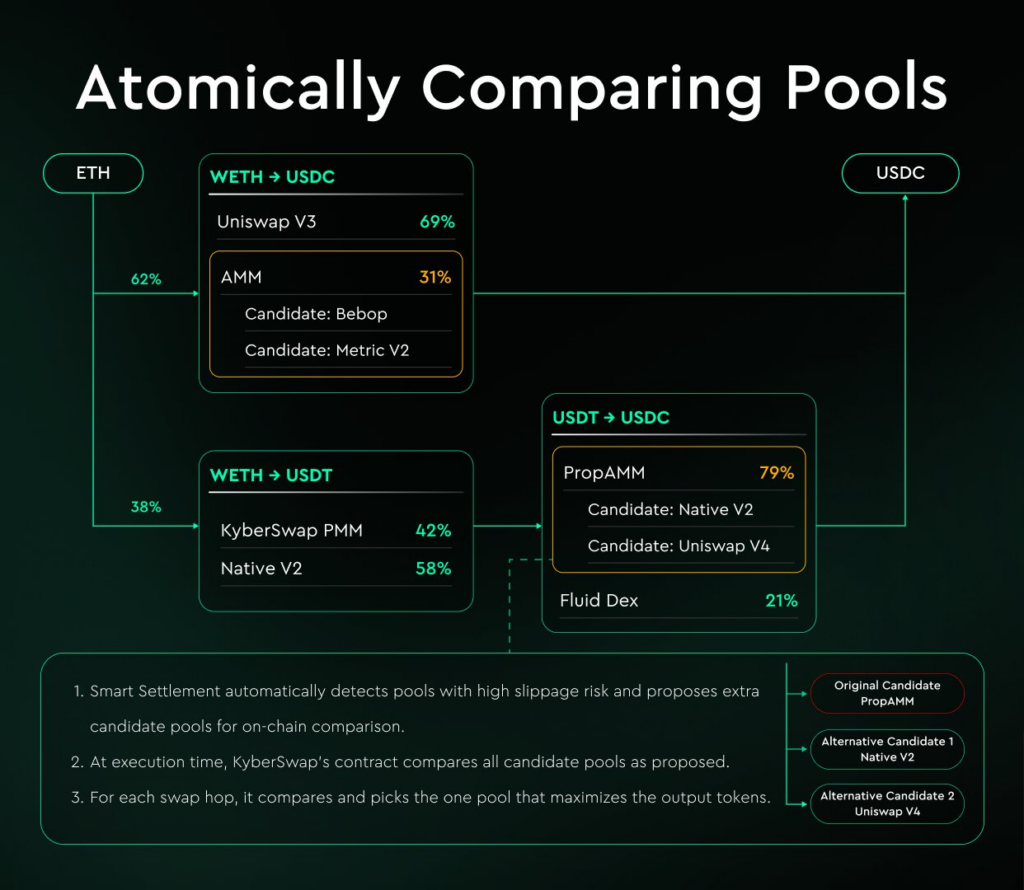
MEV Protection helps reduce the risk of value leakage from harmful MEV activity during execution. This is especially important for larger swaps, volatile tokens and low-liquidity pairs where front-running or sandwich attacks can lead to worse final output.
Smart Settlement for better swap output
KyberSwap’s Smart Settlement is an onchain execution layer for KyberSwap Aggregator. KyberSwap’s Dynamic Trade Routing already finds efficient swap routes across liquidity sources at quote time. Smart Settlement extends this by adding real-time pool comparison at the moment of execution.
This matters in real trading conditions, where PropAMMs often overquote, and MEV takes value from traders. Liquidity can shift between quote and execution. A route that looked best when quoted may no longer be the best when the transaction executes. Smart Settlement helps address that gap by improving the swap outcome at execution time.
More than swaps: Cross-chain Swap, Limit Order, and KyberEarn
KyberSwap is useful beyond instant swaps. Users can access:
- Swap for the best-rate token swaps
- Cross-chain Swap for moving between networks from one interface
- Limit Order for target-price execution
- KyberEarn for discovering opportunities and earning yield
This makes KyberSwap more than a simple routing tool. It becomes a complete DeFi experience hub.
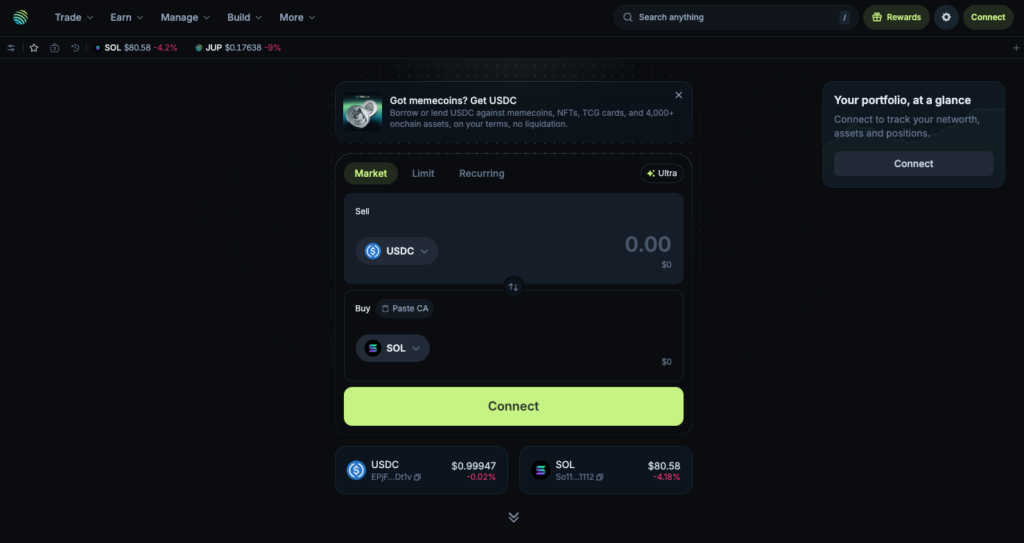
2. Jupiter
Jupiter is one of the leading DeFi platforms on Solana. Unlike many EVM-focused aggregators, Jupiter is strongest for users who mainly trade inside the Solana ecosystem.
Three key offerings:
- Solana swap aggregation for token swaps
- Advanced trading tools such as limit orders and DCA orders
- Perps gives users access to perpetual trading
Jupiter’s documentation describes its products across swaps, lending, limit orders, DCA orders, perps, and more. It also notes that its swap infrastructure is built around best execution on Solana.
Jupiter is a strong choice for Solana-native traders. The main limitation is that it is not a broad EVM aggregator like KyberSwap, OKX DEX, 1inch, or 0x.
3. OKX DEX
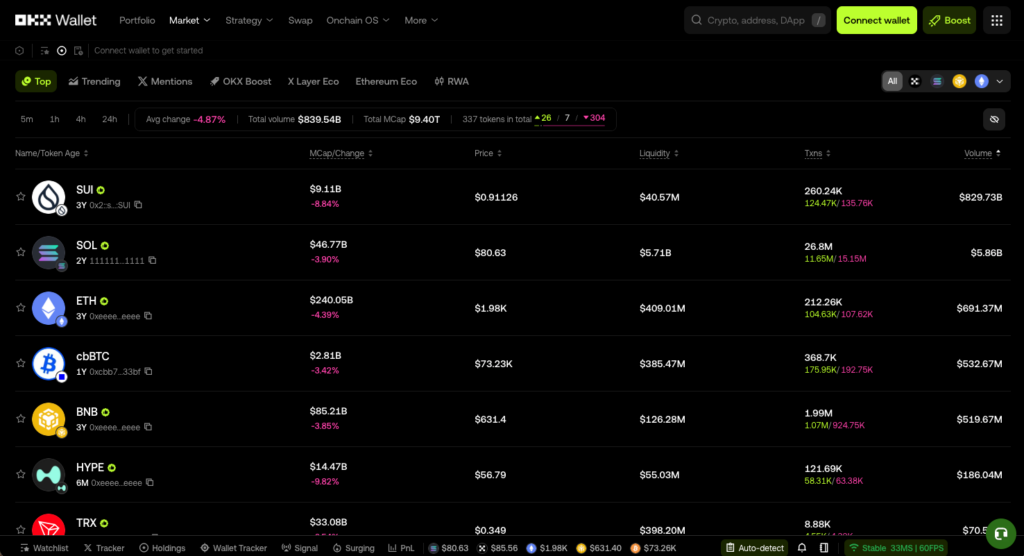
OKX DEX is a multi-chain DEX aggregator with strong chain coverage and a familiar interface for users already inside the OKX Web3 ecosystem.
Two key offerings:
- Meta DEX Aggregator compares routes between multiple DEX Aggregators
- OKX Wallet trading lets users trade directly inside OKX Wallet without switching between multiple apps.
OKX DEX is a strong option for users who want broad chain coverage and a wallet experience connected to the wider OKX Web3 product suite.
4. 0x Aggregator
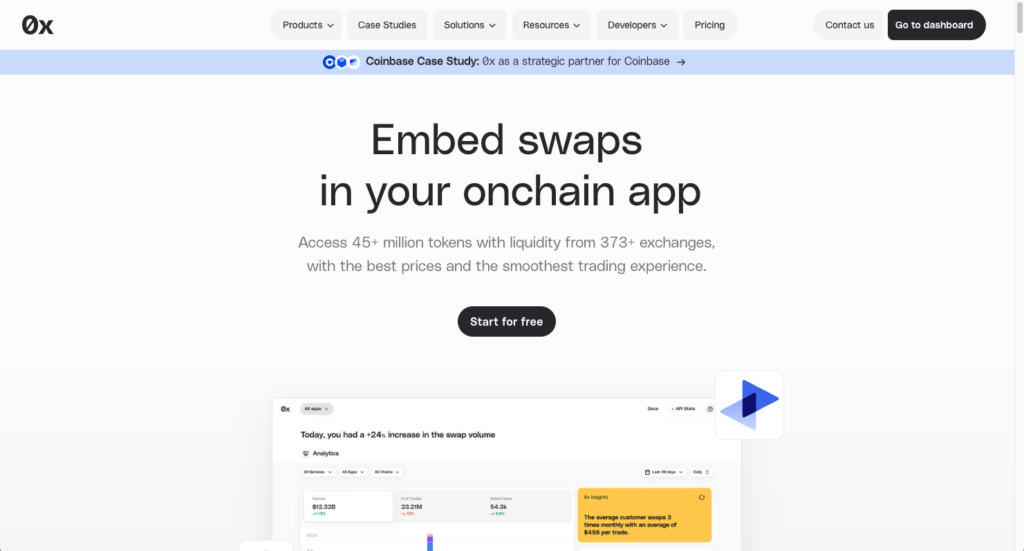
0x powers swaps for wallets, apps, and developers through APIs.
Two key offerings:
- Swap API and Gasless API for smoother trading flows
- Cross-Chain API for swapping tokens between networks
0x describes its Swap API as a way for apps to access aggregated liquidity through a single API.
For end users, 0x may often appear behind the scenes inside another app. For developers, it is a strong swap infrastructure provider.
5. DFlow
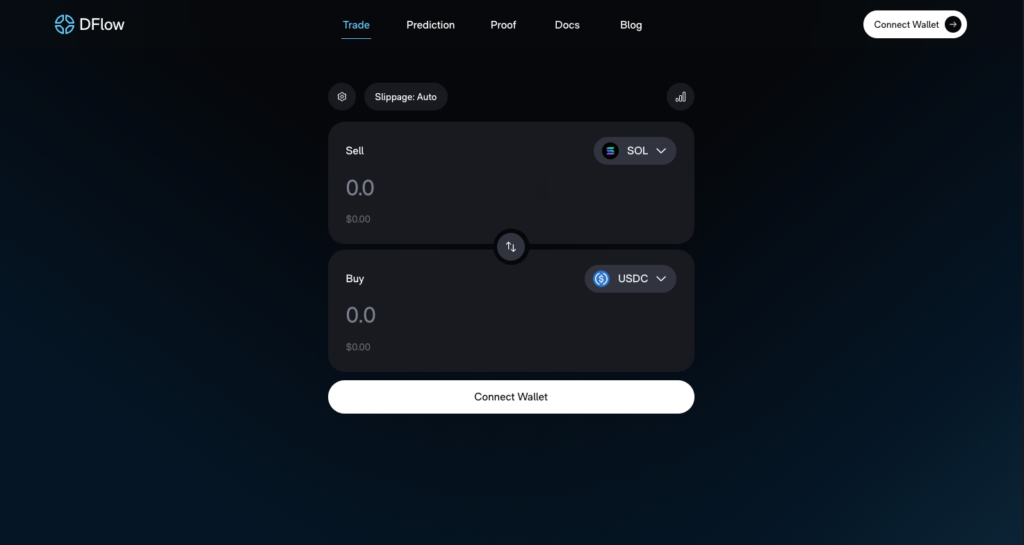
DFlow aggregates liquidity across Solana venues such as AMMs, CLMMs, DLMMs, propAMMs and CLOBs to create a real-time liquidity graph for swap routing. This helps users and integrators access better quote quality across supported Solana liquidity sources.
Two key offerings:
- Solana swap aggregation: routes trades across multiple Solana liquidity venues to help users find better prices.
- Swap API for integrators: lets wallets, trading desks and DeFi apps access DFlow’s liquidity routing through one API.
DFlow is a strong choice for users who mainly trade on Solana and want a fast, execution-focused aggregator. Its main limitation is chain coverage. Compared with multi-chain aggregators like KyberSwap, OKX DEX, 0x and 1inch, DFlow is more specialized around the Solana ecosystem.
6. 1inch
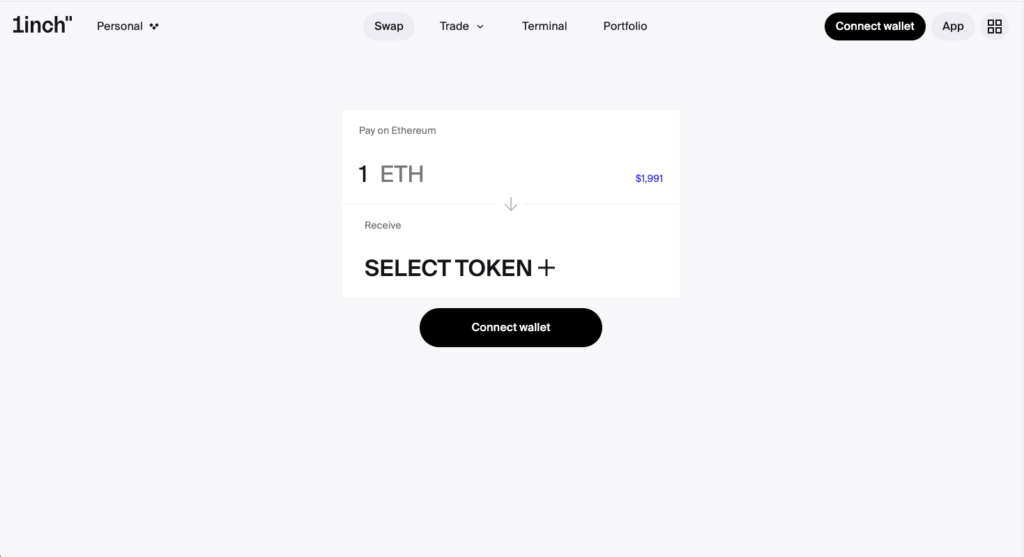
1inch has a long history in aggregation and is often used by traders who want swap routing across major EVM chains.
Two key offerings:
- Aggregation for routing swaps across multiple DEXs
- Limit Order for trades that execute based on user-defined conditions
1inch is a strong option for users who want a well-known aggregator with broad DeFi recognition.
Comparison: Which Token Swap Platform Should You Use?
| Platform | Best For | Main Strength | Limitation |
|---|---|---|---|
| KyberSwap | Best-rate swaps, low slippage and full DeFi flow | #1 DEX aggregator by 30d volume, deep liquidity access, Smart Settlement and a complete DeFi product suite | Best for users who want more than a basic swap screen |
| Jupiter | Solana traders | Strong Solana-native swap aggregation, Limit Orders, DCA, Perps and Earn | Mostly Solana-focused |
| OKX DEX | Multi-chain Web3 users | Meta DEX Aggregator and trading directly inside OKX Wallet | More tied to the OKX Wallet ecosystem |
| 0x Aggregator | Developers and embedded swaps | Strong API infrastructure for apps, wallets and trading platforms | More infrastructure-focused than consumer-focused |
| DFlow | Solana traders and integrators | Fast Solana swap aggregation, low-latency routing and API access | Limited compared with multi-chain aggregators |
| 1inch | EVM power users | Established aggregation, multi-route swaps and limit order tools | Can feel more advanced for beginners |
What Makes a Token Swap Platform Good?
The best token swap platform should help users answer five questions before they confirm a trade.
First, am I getting a competitive rate?
A good aggregator should compare multiple liquidity sources instead of relying on one pool.
Second, how much will I actually receive?
Estimated output is useful, but the minimum received matters more. This is the lowest amount the user accepts before the transaction reverts.
Third, how much slippage risk am I taking?
Low slippage settings can protect users from worse execution but may increase failed transactions. Higher slippage may help transactions execute but can expose users to worse output.
Fourth, is the route efficient?
Good routing considers liquidity depth, price impact, gas cost and split routes.
Fifth, does the platform support my next action?
A strong platform should support more than one swap. Users may need cross-chain execution, limit orders, or yield farming opportunities after trading.
Best Place to Swap Tokens: Final Verdict
For most DeFi users looking for the best rate and low slippage, KyberSwap is the strongest overall choice.
The reason is simple. KyberSwap combines high-volume DEX aggregation with deep liquidity access, smart routing, Max Slippage controls, Minimum Received protection, Smart Settlement and a broader DeFi product suite.
Competitors also have clear strengths. OKX DEX is strong for multi-chain Web3 users. Jupiter is excellent for Solana. 1inch remains a well-known EVM aggregator. 0x is powerful for developer integrations. DFlow is strong for Solana-focused routing and integrators.
But for users who want one place to swap tokens efficiently across DeFi while staying in control of execution, KyberSwap offers the most complete experience.
FAQ
What is the best place to swap tokens for the best rate?
A DEX aggregator is usually the best place to swap tokens for the best rate because it compares multiple liquidity sources. Based on the current DeFiLlama DEX aggregator volume snapshot, KyberSwap ranks #1 DEX aggregator by 30d volume.
Why does low slippage matter?
Low slippage helps protect users from receiving fewer tokens than expected. Slippage can happen when price or liquidity changes between quote and execution.
Which DEX aggregator is best for Solana?
Jupiter is one of the strongest options for Solana-native users. It focuses heavily on Solana trading and offers swaps, limit orders, recurring orders and other Solana DeFi tools.
What is the safest way to swap unfamiliar tokens?
Always verify the token contract address, review price impact, check minimum received and avoid setting slippage too high. For low-liquidity tokens, trade carefully and consider smaller swap sizes.