Crypto yield in 2026 comes in many forms, from lending and liquid staking to fixed-yield markets and liquidity provision. Each platform serves a different type of user. For users comparing the best places to earn yield on crypto, the key is not only the advertised APR. It is also important to consider ease of use, risk visibility, position management and how easily users can enter or exit opportunities. This guide compares five major platforms for Best Places to Earn Yield on Crypto in 2026: Aave, KyberSwap, Pendle, Lido, and Curve.
Top Places to Earn Yield on Crypto in 2026
| Platform | Best For | Main Yield Type |
|---|---|---|
| Aave | Lending and borrowing | Supply and borrow APR |
| KyberSwap | All-in-one liquidity management platform | Pool fee, liquidity mining and bonus rewards from third-party protocols |
| Pendle | Yield-trading | PT/YT yield markets |
| Lido | ETH staking yield | Liquid staking |
| Curve | Stablecoin and pegged-asset liquidity | LP fees, CRV incentives, scrvUSD |
1. Aave: Best for Lending and Borrowing Yield
Aave is one of the most established DeFi lending protocols.
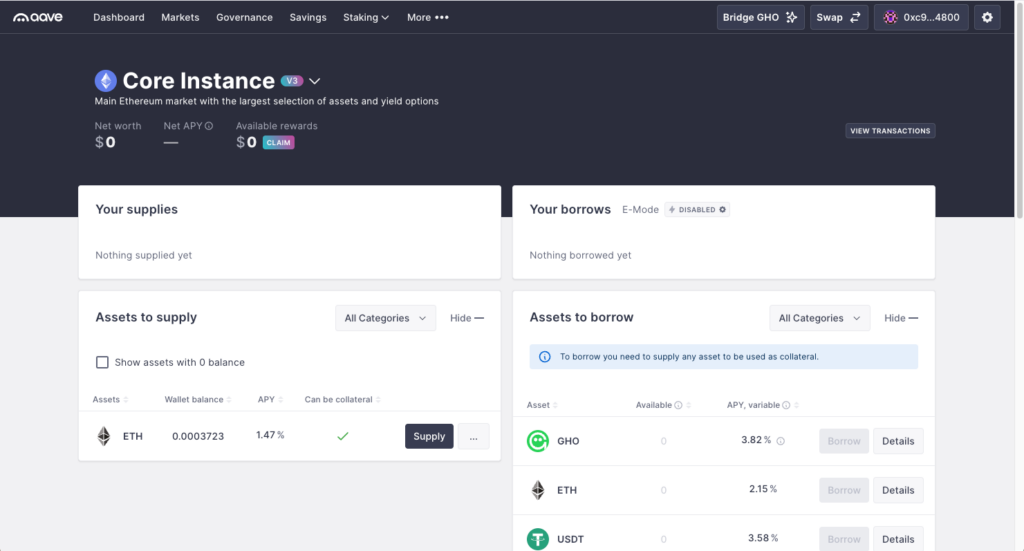
It lets users supply crypto assets to earn interest and allows borrowers to access liquidity by providing collateral. Aave describes itself as a decentralized non-custodial liquidity protocol where suppliers provide liquidity to earn interest and borrowers access liquidity through overcollateralized borrowing.
Main Aave Offerings
Supply assets: Users deposit assets into lending markets and earn variable interest.
Borrow assets: Users borrow against collateral without selling their holdings.
Aave Umbrella: A modular, onchain risk management system that automates bad debt coverage for Aave v3 pools.
Aave is best for users who want lending yield rather than LP yield. It is generally easier to understand than more complex LP strategies because users supply one asset and earn interest based on market demand.
However, yields can fluctuate. Borrowing also introduces liquidation risk if collateral value drops. Aave is strong for blue-chip DeFi lending with well-established security.
2. KyberSwap: Best All-in-One Place to Earn Yield on Crypto
KyberSwap is the best option for users who want more than a list of APRs.
Instead of forcing users to jump across separate DEXs, liquidity dashboards, swap tools and exit trackers, KyberSwap brings the earning workflow into one interface, including well-established protocols like Uniswap, PancakeSwap, and Aerodrome. KyberEarn lets users discover, enter and manage liquidity positions across multiple protocols, while KyberZap helps simplify the process of adding or exiting liquidity.
This matters because earning yield from liquidity pools can be complicated. Users often need to pick the right pool, prepare the correct token ratio, compare APR sources, monitor price ranges and decide when to exit. KyberSwap reduces this friction through three key products: KyberEarn, KyberZap and Smart Exit.
KyberEarn
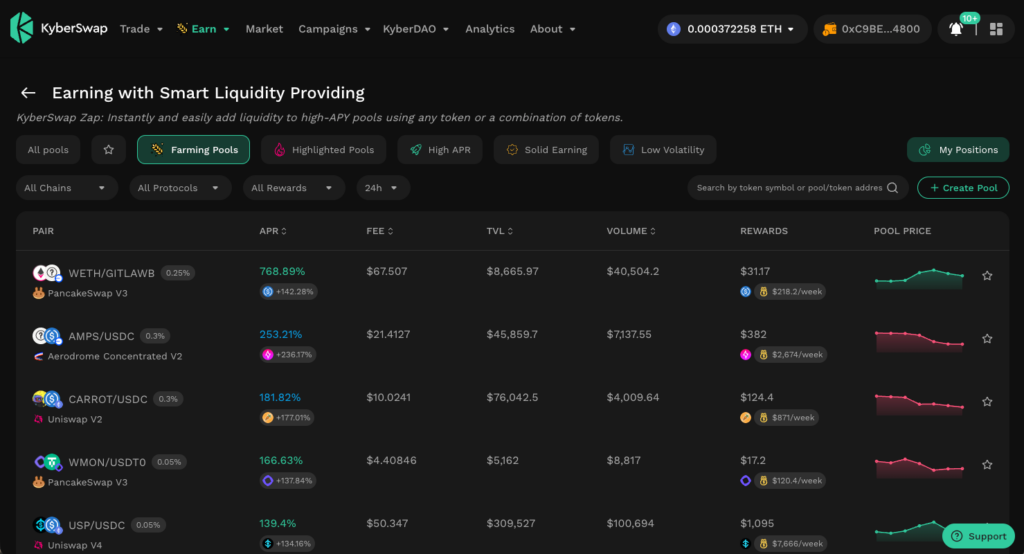
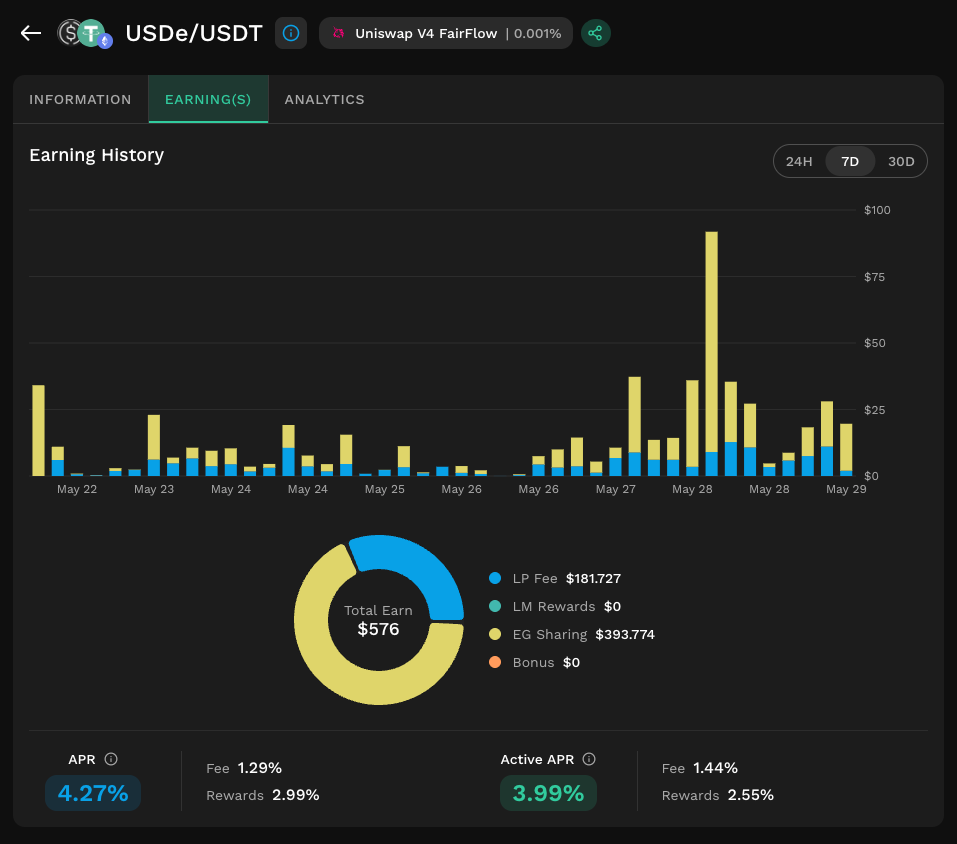
KyberEarn is designed to make DeFi yield discovery easier. Users can explore liquidity opportunities, compare pool data and manage positions from a cleaner analytic dashboard.
The main benefit is convenience. Instead of manually checking multiple protocols, users can use KyberEarn to evaluate earning opportunities in one place. This is useful for LPs who want to compare APR, pool performance, position status and available rewards before entering a position.
KyberEarn is especially valuable for users who want a more informed liquidity strategy. The goal is not only to “find high APR” but to understand what drives that APR and gain insight to decide the next action.
KyberZap
KyberZap solves one of the most annoying problems in DeFi liquidity provision: getting the right token ratio.
Traditional LP positions often require users to hold both tokens in the correct proportion. If the user only has one token, they usually need to swap manually first. That means more steps, more decisions and more chances to make mistakes.
KyberZap makes this easier by letting users zap into liquidity positions with single or up to 5 tokens. It can also support zap out and position migration flows, reducing the need for manual swap-then-deposit steps.
Smart Exit
Earning yield is only half the story. Exiting at the right time can be just as important.
Smart Exit helps liquidity providers manage exit conditions so they do not need to monitor positions constantly. This is useful for LPs who want to protect gains, reduce manual timing stress or exit based on predefined conditions. Smart Exit is built around the challenge of deciding when to exit a liquidity position.
For active LPs, this can be a major improvement. Many yield strategies fail not because the user picked the wrong pool but because they did not manage the position after entering. Smart Exit gives users a more structured way to manage that risk.
Why KyberSwap Stands Out
KyberSwap stands out because it covers more of the full DeFi yield journey:
- Discover earning opportunities
- Analyze earning performance and insight
- Enter positions with fewer manual steps
- Use Zap to simplify liquidity provision
- Track and manage LP positions
- Exit smarter with Smart Exit
That makes KyberSwap more than a yield page. It is a full workflow for DeFi users who want to earn, trade and optimize in one place.
3. Pendle: Best for Yield Trading
Pendle is one of the most popular platforms for users who want to trade yield directly.
Its core idea is simple: separate yield-bearing assets into principal and yield components. This allows users to earn fixed yield, trade future yield or take directional views on yield markets.
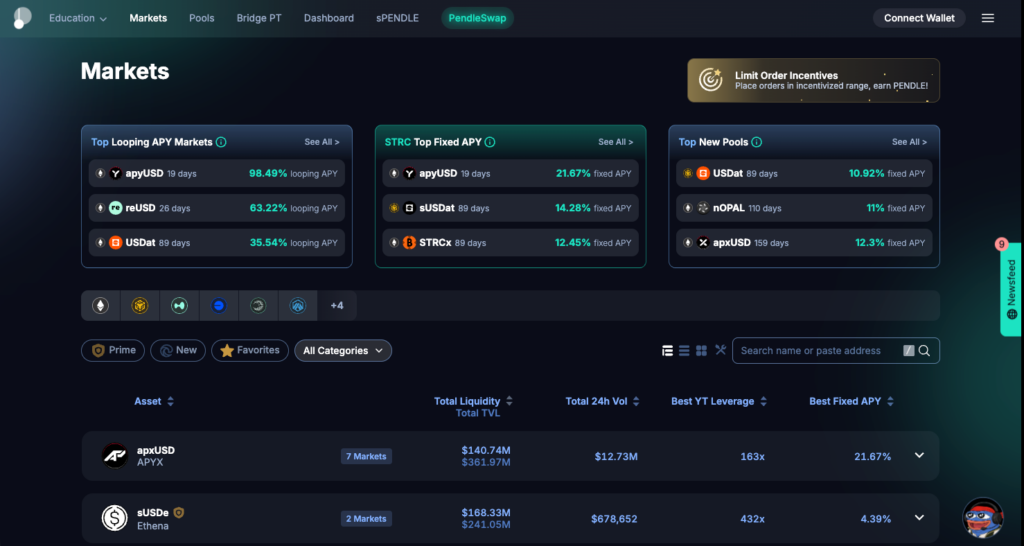
Pendle describes itself as a crypto yield trading platform where users can trade spot yield, earn fixed yield or go long yield through its V2 product. It also highlights Boros Margin for trading yield with leverage.
Main Pendle Offerings
Fixed yield: Users can lock in a predictable yield by buying discounted principal tokens.
Long yield: Users can buy yield tokens if they believe future yield will be higher.
Yield trading: Pendle is useful for advanced users who want to trade rate expectations rather than simply deposit into a pool.
Pendle is powerful but it is not the easiest platform for beginners. Users need to understand maturity dates, PT, YT, implied APY and market liquidity. For experienced DeFi users, it can be one of the best places to find structured yield.
4. Lido: Best for ETH Liquid Staking Yield
Lido is one of the most well-known liquid staking protocols for Ethereum.
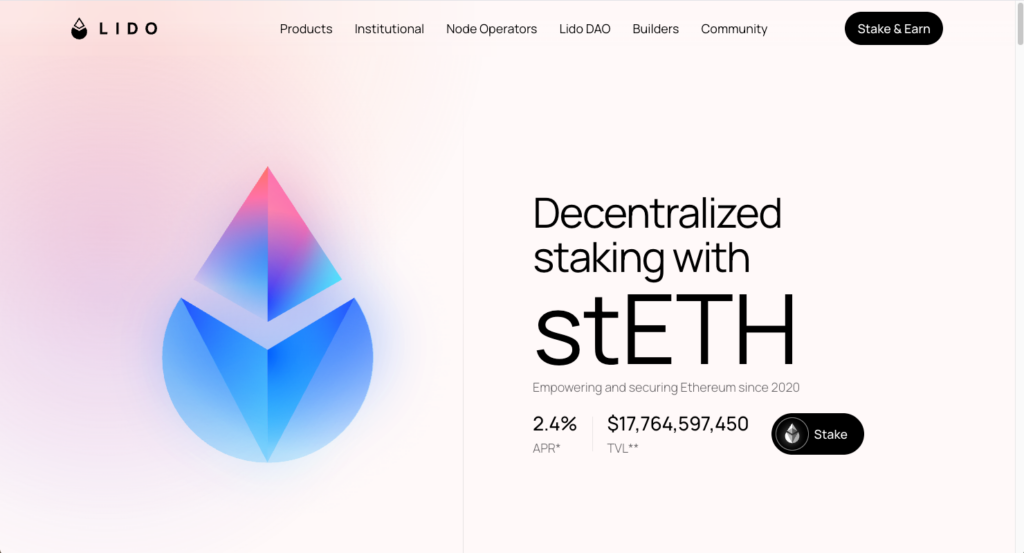
It allows users to stake ETH and receive a liquid staking token, stETH, which represents staked ETH and can be used across DeFi. Lido explains that liquid staking tokens can accrue rewards and remain transferable, usable in DeFi or redeemable for ETH.
Main Lido Offerings
stETH: Users can stake ETH and receive stETH.
Lido Earn: Lido offers EarnETH and EarnUSD products for on-chain reward opportunities.
DeFi composability: stETH can be traded, used as collateral or used in other DeFi strategies.
Lido is best for users who mainly want ETH staking yield while keeping liquidity. It is simple compared with active LP strategies and useful for long-term ETH holders.
The tradeoff is that Lido is more focused on staking than broad yield discovery. If your main goal is to explore LP opportunities across ecosystems, KyberSwap is more flexible. If your main goal is ETH staking exposure, Lido is more specialized.
5. Curve: Best for Stablecoin and Pegged-Asset Yield
Curve is one of the most important DeFi venues for stablecoin and pegged-asset liquidity.
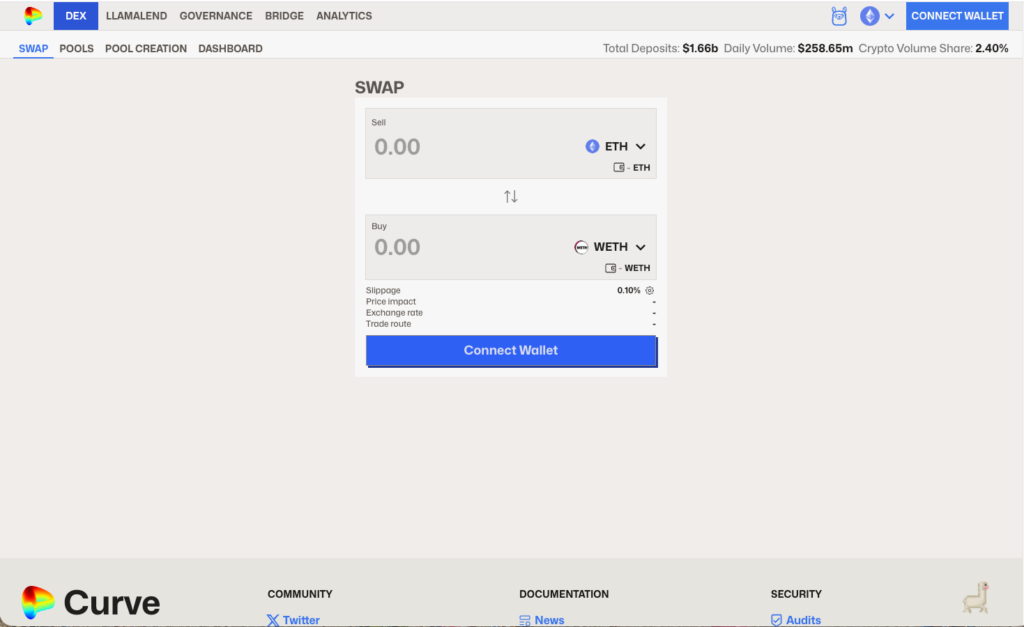
Users can deposit assets into Curve pools and receive LP tokens. These LP tokens can earn yield from trading fees and other rewards. Curve resources explain that users who deposit into pools receive LP tokens and can earn multiple types of yield.
Main Curve Offerings
Liquidity pools: Users provide liquidity to stablecoin or pegged-asset pools.
Reward gauges: Users can stake LP tokens in gauges to earn rewards, often in CRV.
scrvUSD: Curve introduced Savings crvUSD, a yield-bearing version of crvUSD that provides autocompounding interest on crvUSD deposits.
Curve is best for users who want stablecoin-related DeFi yield and are comfortable with LP mechanics. It can be powerful but its interface and ecosystem can feel complex for new users.
KyberSwap has an advantage for users who want a cleaner discovery and management layer for LP opportunities, especially with Zap and Smart Exit.
Which Platform Should You Use?
The best platform depends on your goal.
Use Aave if you want lending yield from supplying assets.
Use Pendle if you want fixed yield or want to trade future yield.
Use KyberSwap if you want an all-in-one DeFi yield workflow with LP discovery, Zap, Earn analytics and Smart Exit.
Use Lido if you mainly want ETH staking yield through stETH.
Use Curve if you want stablecoin or pegged-asset liquidity pool yield.
That is where KyberSwap is especially strong.
FAQ
Is Aave good for passive crypto yield?
Aave can be a good option for users who want lending yield by supplying assets. However, supply APR changes based on market demand and DeFi risks still apply.
Is Pendle better than KyberSwap for yield?
Pendle is better for fixed yield and yield trading. KyberSwap is better for users who want a broader DeFi earning workflow with LP discovery, Zap and position management.
Is KyberSwap only for swapping?
No. KyberSwap supports more than token swaps. Its interface includes trading tools and earning opportunities such as Swap, Limit Order, Cross-chain Swaps and KyberEarn.
Is Lido good for ETH yield?
Lido is a strong option for ETH liquid staking. Users can stake ETH, receive stETH and use stETH across DeFi while earning staking rewards.
Is Curve still useful for earning yield?
Yes. Curve remains useful for stablecoin and pegged-asset liquidity. Users can provide liquidity, stake LP tokens in gauges and explore products like scrvUSD.
What is the biggest risk of earning crypto yield?
The biggest risks include smart contract risk, impermanent loss, liquidation risk, token price volatility and changing APR. Higher yield usually comes with higher complexity or higher risk.